Installation
HVAC installation in Springdale, sized to the house
We use the latest technology and best practices to install your system correctly and efficiently, and we size it with a real load calculation before anything is ordered.
Chapter 01
Sizing with a Manual J load calculation, not a guess
The size of a new system is the decision everything else rests on, and it is the one most often made by looking at the old unit and ordering the same tonnage. Osage Air runs a professional Manual J load calculation instead. We come to the house, gather the data, and work out how much air the home and each individual room needs to stay comfortable.
A load calculation accounts for the things that actually move heat in and out of a house: square footage, insulation, the windows and which way they face, the duct layout, how leaky the envelope is. A rule of thumb by square foot cannot see any of that, and two houses of the same size can need very different equipment.
The old system is not the answer key either. New windows, added insulation, a tree that came down or one that grew up all change the load, so the unit that was right in 2010 may be oversized or undersized today. New installations get a free estimate, and the number behind it is a calculation rather than a hunch.
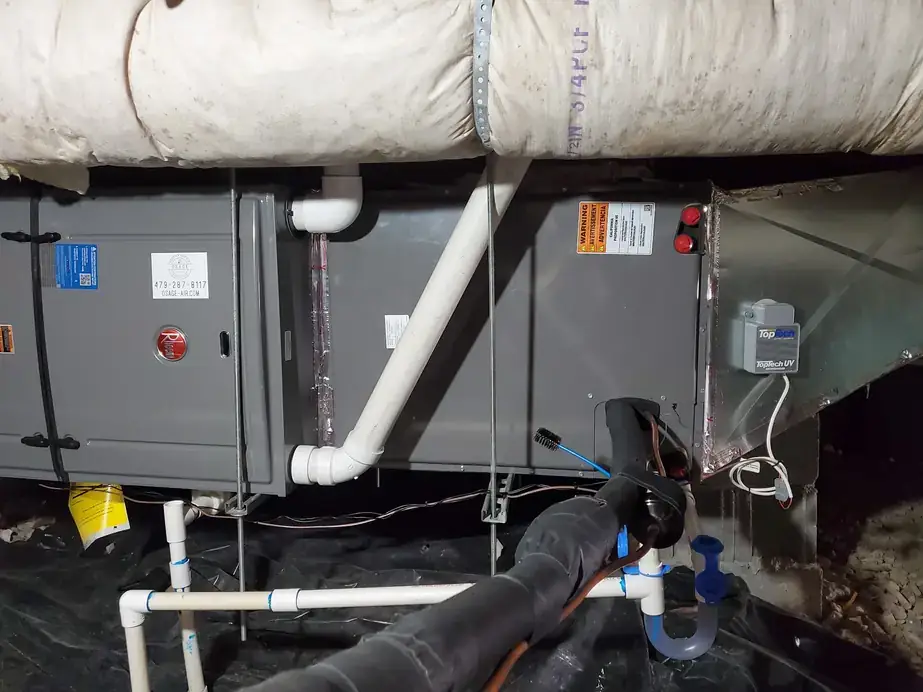
An Osage Air air handler install with the condensate trap plumbed
Why an oversized system leaves a house cold and damp
Bigger sounds safer, and it is not. An air conditioner takes humidity out of the air by moving that air across a cold evaporator coil, and the slower and longer the air travels over the coil, the more moisture comes out. A system that is too large cools the space quickly, satisfies the thermostat and shuts off before it has dried anything.
What the homeowner feels is a house that reads cool but sits clammy, with short bursts of cold air and a thermostat that keeps clicking on and off. Humidity removal is a byproduct of a correctly sized system, and an oversized one gives that up. All those short starts are also harder on the equipment than a steady, longer run.
Too small has its own failure, a unit that runs flat out all afternoon and never catches up. The load calculation is how we land between the two, and it is why we would rather size a system on paper first than find out after the install.
Chapter 03
Options at every budget, with warranties up to 12 years on replacements
We do not hand you one number and wait. You get different options for the replacement, built around different budgets, and financing options are available when the whole system at once is a stretch. Which one you choose is your decision; our job is to say plainly what we think fits the house.
Each option carries its own level of warranty. Service work is covered from 30 days out to 2 years, and replacements carry up to 12 years of parts and labor. Ask to see what each tier covers side by side, because the gap between the options is usually in those terms as much as in the equipment.
Amanda Ferguson was without cooling in a new place for two weeks when she called. Grant was at her house within days, she signed the quote within days, and the install was on the schedule for the following week. Her line about the quote is the standard we hold: no more than what she wanted or needed. If you are weighing a repair against a replacement first, our rule is that a fix passing about 10% of the cost of a new system is the point to look at options. See how that plays out on our heating and air conditioning pages.
"...didn't try to sell me more than what I want or need." Amanda Ferguson, Google review
Single stage, two stage and inverter, told with a car
Equipment brochures bury the difference between stages in jargon. We use the air conditioner in your vehicle instead, because everyone has stood in a hot car with the dial in their hand.
- Single stage
- Think of climbing into a hot car and turning the AC to high. When you reach a comfortable temperature you shut it off completely. A single stage system works the same way: full output whenever it runs, and off when the house is satisfied.
- Two stage
- You get close to comfortable and turn the blower down so it does not work as hard. A two stage system has a lower gear for mild days and a higher one for the worst afternoons, so it spends more of its time in the quieter, steadier setting.
- Inverter
- You use every setting for temperature and blower speed, adjusting all the way along. An inverter system does that on its own, varying its output continuously instead of jumping between a few steps. Repairs on inverter and variable speed equipment with high SEER ratings cost more than repairs on single stage equipment, which is worth weighing when you compare options.
$250 off your system replacement
Use promo code OSAGE-250 when you book a system replacement with us and take $250 off. New installations also get a free estimate, so the first conversation costs you nothing.
Military and senior discounts are always available, and members of the Osage Air Club earn money toward a replacement through their yearly visits.
Ask for a free estimate on your new system
Call and tell us about the house. We will set a time to gather the numbers and go through your options.